 |
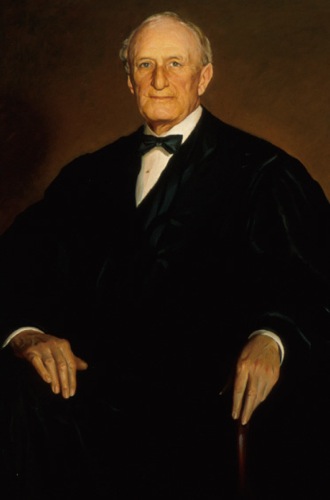
| James McReynolds (Source: Wikipedia) |
McReynolds refused to hire Jews and blacks as law clerks, but changing social mores forced him to risk interacting with them on a day to day basis. They appeared as colleagues (Justices Brandeis and Cardozo were both Jews) and counsel before the bench (Charles Houston, special counsel for the NAACP, was black). McReynolds handled these offenses to his sense of propriety by reducing the amount of time he was required to look at them.
He treated Louis Brandeis, the first Jewish Supreme Court Justice, poorly. During Justice Brandeis' first three years on the bench McReynolds didn't speak with him once and refused to sit near him on occasions when the Justices appeared in public. We don't have a 1924 group portrait of the Supreme Court because seniority dictated that McReynolds sit next Brandeis in the photograph. McReynolds refused to participate forcing Chief Justice Taft to cancel the photo session. Mere spatial distance was not enough: even when he agreed with Brandeis' opinion McReynolds refused to sign on to them.
His treated Benjamin Cardozo worse. According to the memoir of one of McReynolds' former clerks, who was fond of Cardozo, McReynolds never spoke to Cardozo. Apparently because Cardozo once had the temerity to suggest a few additions to an opinion McReynolds circulated for comment. No doubt McReynolds was also stung that the White House ignored his plea (signed by two other Justices!) that the White House "not afflict the court with another Jew." Rather than watch another member of the tribe of Abraham get sworn in, McReynolds read a paper during Cardozo's swearing in ceremony. McReynolds continued this practice as long as they both sat on the Supreme Court, covering his face with court documents whenever Cardozo read an opinion from the bench.
As a Justice required to uphold and embody the ideal of equality before the law his treatment of NAACP special counsel Charles Houston was inexcusable. Chief architect of the NAACP's multi-year strategy for overturning Plessy v. Furgeson, Houston presented his first argument to the United States Supreme Court in the case Missouri ex rel. Gaines v. Canada. The case involved a black man seeking to be admitted to the only law school in the state of Missouri, which also had a white's only admission policy. As Houston approached the bench McReynolds, true to his philosophy of out of sight, out of mind, turned his chair around and kept his back turned during Houston's oral argument. When Houston finished arguing McReynolds turned his chair back around. Houston won the case and McReynold's wrote a dissent warning that allowing blacks into Missouri's only law school would "damnify both races."
Brandeis, Cardozo, and Houston all put up with McReynolds' slights because they were new members at the table of power. The fact that two other justices objected to the nomination of Cardozo, one of the greatest legal minds of the 20th century, reveals that their experiences with McReynolds were probably a small sampling of the slights and mistreatment the three men received as minorities entering the WASPiest of professions. No matter how bad things may go at the Bar, it won't be as bad as going up to argue before the Supreme Court and having a Justice turn his back on me.


No comments:
Post a Comment